
In the past few months, I gave my Apple Music subscription another chance, but ended up canceling it simply because I couldn’t easily…
In the past few months, I gave my Apple Music subscription another chance, but ended up canceling it simply because I couldn’t easily access the music I wanted. So I switched back to Spotify. It’s not like Spotify has a highly user-friendly interface either. Let’s just say it’s out of necessity. On the other hand, I had to remove Turkcell’s free Fizy service from my phone after a few trials. I realized that it cannot be an alternative to others, even for testing purposes. When I look at forum comments and social media criticisms, I see that many people feel the same way I do. If only they had allocated even a small portion of the marketing and promotional budget to improving the user experience, the product would be in a completely different place today. So what’s the problem? Managing without design-oriented thinking…
Why is design important? Design is about the part of the product that the end user — meaning the customer — sees, touches, and feels. So yes, the code or content inside the app matters, but how the user interacts with it is far more important. While design once evoked ideas of chicness and luxury for mass audiences, in recent years, as technology has extended beyond screens into the chairs we sit on, the walls we look at, and the shoes we wear, design has gained much more importance. What we really mean by design is the experience the customer has when purchasing and using the product, the touchpoints where they interact with it, and the feelings they have while using it. And it doesn’t end with the purchase. It includes designing the entire process between the production teams deciding to create the product and the customer’s experiences until the end of its lifecycle.
The need for design-based thinking entered our lives as physical and digital worlds merged, bringing experiences to the forefront. In our suddenly intensified lives, design gained importance by creating shortcuts that allow us to do things more comfortably and, when needed, much faster.
This convergence of digital and real worlds has also brought forth hybrid expertise. Today, we are in a period where architects, fashion designers, marketing specialists, web designers, and circuit designers are employed under the same roof, producing projects together, and even intervening in each other’s fields. Offices, homes, public spaces, mobile apps, virtual reality content, and websites — all these projects are designed using design-thinking methods to make users’ lives easier.

With design-oriented and user-experience-centric thinking, public spaces, communal living centers, social facilities, and services are also being designed. While well-designed transportation systems make a city much more livable, poorly designed main arteries cause heavy traffic, leading to both economic and psychological losses. For example, the metro station I got off at while coming to the café I’m sitting in now (Bağlarbaşı Station — Üsküdar) is so poorly designed in terms of train entry and exit that while it’s possible to reach the surface in just two steps, the mispositioned staircases make it much harder. Moreover, in a potential emergency, a congested evacuation is likely. Years ago, when TÜBİTAK and the Istanbul Municipality jointly analyzed Metrobus passenger traffic and introduced new lines, bottlenecked stations became somewhat relieved. These examples can be multiplied. To build much more livable cities, we need to popularize design-based thinking processes.
Design-thinking methods make life easier while also guiding and easily educating communities. Structuring processes in service areas that appeal to large populations — such as education, taxation, health, payments, and collections — through design-based thinking not only simplifies life but also enables significantly lower resource consumption.
Richard Thaler won the 2017 Nobel Prize in Economics for his research and model development in this field. I highly recommend reading his book “The Nudge,” translated into Turkish as “Dürtme,” which he wrote on user-experience process design and behavioral economics.
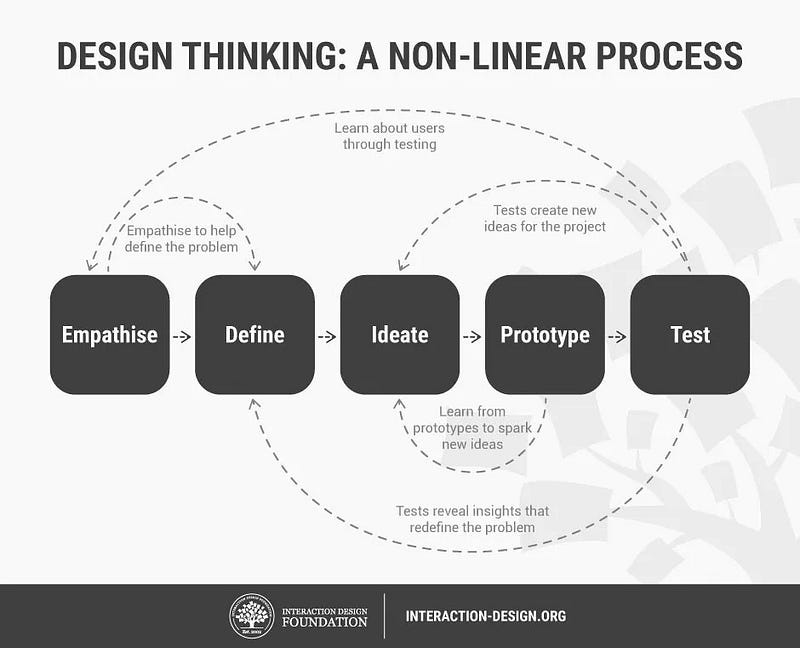
Design-Based Thinking System
To apply the design-based thinking system, we can implement the 5 steps developed by Nobel laureate Herbert Simon and thus deliver value-creating and life-easing applications and decisions both in daily life and in our workplaces — regardless of our industry.
Empathize:
Empathize with your users. Try to understand why they use your product and what they might encounter.
Define:
Identify your users’ needs, problems, and insights.
Ideate:
Design solutions for the problems, issues, and needs you have defined. Product, space, or process — whatever the need is, design for it.
Prototype:
Create prototypes to bring your designed solutions to life.
Test:
Test these prototypes. Are you truly achieving the results you want? Observe it.
Coming back to music service selection: for now, I’m continuing with Spotify. But an information architecture that helps me find exactly what I want among millions of songs, and an app interface that contains only useful functions, still hasn’t been built. This requires deep thinking and the ability to meaningfully interpret large datasets. Apple’s interface, however, was a complete disappointment. For a company that popularized user experience design globally to develop such a product is truly a major letdown. Just like designing the world’s ugliest USB and HDMI dongles for its beautifully designed MacBooks…
Kamil Mehmet ÖZKAN