
Introduction
Introduction
Google’s 2025 Helpful Content Update represents a fundamental shift in how search engines evaluate and rank content. This isn’t merely another algorithmic tweak — it’s a paradigm shift that demands immediate attention from Chief Marketing Officers and digital marketing leaders worldwide. The update signals a clear message: the era of creating content primarily for search engines is over. Today, success belongs to brands that prioritize user value above all else.
For marketing executives, this update presents both a challenge and an opportunity. Those who adapt quickly will see their organic visibility soar, while those who cling to outdated practices risk being pushed to the margins of search results. Let’s explore what this update means and how you can position your organization to thrive in this new landscape.
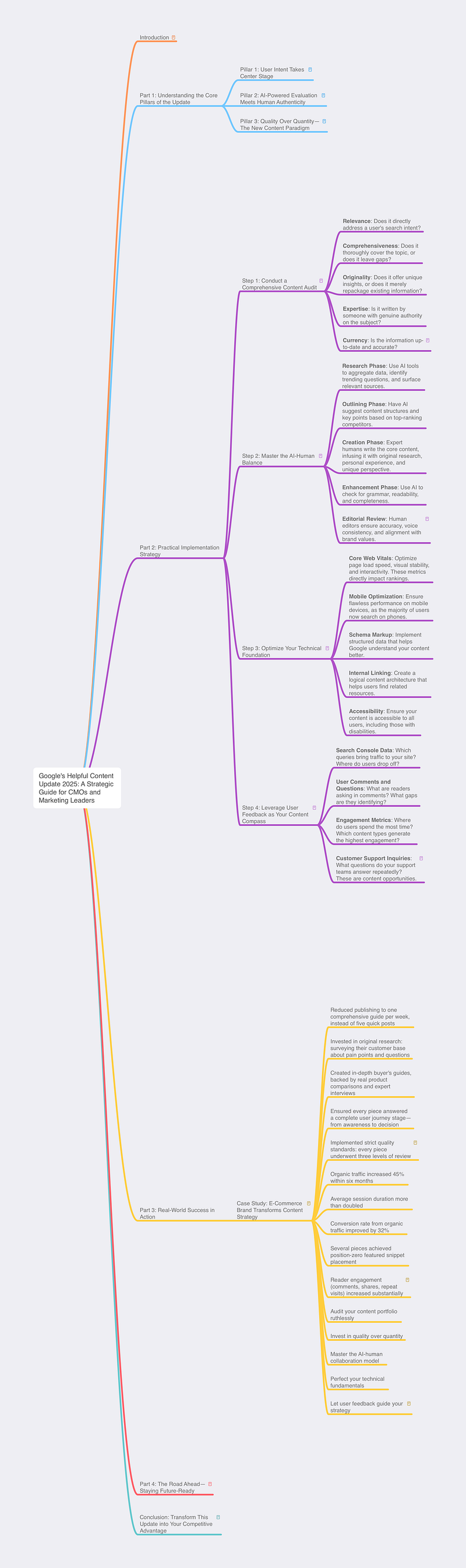
Part 1: Understanding the Core Pillars of the Update
Pillar 1: User Intent Takes Center Stage
The most significant change in Google’s 2025 framework is the unwavering emphasis on user intent. Gone are the days when keyword density and optimized meta descriptions alone could secure top rankings. Today’s algorithm demands that content directly and comprehensively address what users are actually searching for.
Consider this: when someone searches for “sustainable packaging solutions for e-commerce,” they’re not looking for a generic overview. They want actionable insights, real-world comparisons, cost-benefit analyses, and perhaps even case studies from businesses like theirs. Surface-level content that merely touches on the topic will no longer satisfy Google’s evaluation criteria.
For CMOs, this means investing heavily in audience research. Understand your users’ pain points, questions, and decision-making processes. Create content that serves as a genuine resource, not just a marketing touchpoint. This shift requires a deeper understanding of your target audience and their journey — something that goes beyond traditional keyword research.
Pillar 2: AI-Powered Evaluation Meets Human Authenticity
Google’s 2025 update harnesses sophisticated artificial intelligence to evaluate content quality, coherence, and reliability. The algorithm now assesses whether content is genuinely helpful or merely optimized for algorithms. It checks for natural language patterns, detects inconsistencies, and identifies whether content demonstrates true expertise.
However — and this is crucial — AI evaluation doesn’t mean AI-generated content will automatically rank higher. In fact, the opposite is often true. Google can now distinguish between content created by humans with genuine expertise and content generated purely by artificial intelligence. The sweet spot lies in hybrid approaches: using AI tools to enhance research, streamline workflows, and identify gaps, while ensuring human experts refine, validate, and add authentic voice and insight.
For marketing teams, this means reimagining your content production workflow. AI should amplify human expertise, not replace it. Your subject matter experts, storytellers, and editors remain irreplaceable. They bring credibility, nuance, and the human element that resonates with audiences.
Pillar 3: Quality Over Quantity — The New Content Paradigm
The shift from quantity to quality cannot be overstated. Marketing teams accustomed to publishing three to five blog posts weekly should brace for a strategic pivot. The 2025 update rewards comprehensive, well-researched, deeply insightful content over high-volume publishing.
This doesn’t mean you should publish less frequently, but rather that each piece should deliver genuine value. A 3,000-word article that thoroughly explores a topic will outperform five 600-word pieces that skim the surface. This shift also extends to your entire content portfolio — thin, low-value pages that don’t serve a clear user purpose may actively harm your site’s overall SEO performance.
For CMOs, this necessitates a recalibration of content KPIs. Move beyond vanity metrics like page views and article count. Instead, focus on metrics that reflect user satisfaction: time on page, scroll depth, return visits, shares, and most importantly, whether users return to solve similar problems in the future.
Part 2: Practical Implementation Strategy
Step 1: Conduct a Comprehensive Content Audit
Before moving forward, you need a complete picture of your current content landscape. Analyze your entire content portfolio — blog posts, guides, product pages, landing pages — and evaluate each piece against these criteria:
- Relevance: Does it directly address a user’s search intent?
- Comprehensiveness: Does it thoroughly cover the topic, or does it leave gaps?
- Originality: Does it offer unique insights, or does it merely repackage existing information?
- Expertise: Is it written by someone with genuine authority on the subject?
- Currency: Is the information up-to-date and accurate?
Content that scores poorly across these dimensions should be consolidated, updated, or removed entirely. Thin content that doesn’t serve a clear purpose can actually drag down your site’s overall quality score in Google’s evaluation.
Step 2: Master the AI-Human Balance
Implement a structured workflow that leverages AI while maintaining human oversight:
- Research Phase: Use AI tools to aggregate data, identify trending questions, and surface relevant sources.
- Outlining Phase: Have AI suggest content structures and key points based on top-ranking competitors.
- Creation Phase: Expert humans write the core content, infusing it with original research, personal experience, and unique perspective.
- Enhancement Phase: Use AI to check for grammar, readability, and completeness.
- Editorial Review: Human editors ensure accuracy, voice consistency, and alignment with brand values.
This iterative process combines the efficiency of AI with the credibility and nuance that only humans can provide.
Step 3: Optimize Your Technical Foundation
Content quality alone isn’t enough. Ensure your technical infrastructure supports user experience:
- Core Web Vitals: Optimize page load speed, visual stability, and interactivity. These metrics directly impact rankings.
- Mobile Optimization: Ensure flawless performance on mobile devices, as the majority of users now search on phones.
- Schema Markup: Implement structured data that helps Google understand your content better.
- Internal Linking: Create a logical content architecture that helps users find related resources.
- Accessibility: Ensure your content is accessible to all users, including those with disabilities.
Step 4: Leverage User Feedback as Your Content Compass
Your users are your best guides to improvement. Actively monitor:
- Search Console Data: Which queries bring traffic to your site? Where do users drop off?
- User Comments and Questions: What are readers asking in comments? What gaps are they identifying?
- Engagement Metrics: Where do users spend the most time? Which content types generate the highest engagement?
- Customer Support Inquiries: What questions do your support teams answer repeatedly? These are content opportunities.
Create a feedback loop where user insights directly inform your content strategy. This ensures you’re always addressing real needs rather than assumed ones.
Part 3: Real-World Success in Action
Case Study: E-Commerce Brand Transforms Content Strategy
Consider a mid-sized e-commerce brand specializing in sustainable home goods. Initially, they were publishing two blog posts per week — quick, keyword-optimized articles covering topics like “eco-friendly living tips” and “sustainable home decor ideas.” Their organic traffic was stagnating, and the content generated minimal engagement.
Recognizing the shift signaled by Google’s 2025 update, they completely reimagined their approach:
The Strategy:
- Reduced publishing to one comprehensive guide per week, instead of five quick posts
- Invested in original research: surveying their customer base about pain points and questions
- Created in-depth buyer’s guides, backed by real product comparisons and expert interviews
- Ensured every piece answered a complete user journey stage — from awareness to decision
- Implemented strict quality standards: every piece underwent three levels of review
The Results:
- Organic traffic increased 45% within six months
- Average session duration more than doubled
- Conversion rate from organic traffic improved by 32%
- Several pieces achieved position-zero featured snippet placement
- Reader engagement (comments, shares, repeat visits) increased substantially
What made the difference? The brand stopped treating content as a volume play and started treating it as a strategic asset. They aligned their content with actual user needs and backed it with genuine expertise and research.
Part 4: The Road Ahead — Staying Future-Ready
As we move deeper into 2025 and beyond, the trends are clear:
Search is becoming more answer-centric. Users expect immediate, accurate, comprehensive answers. Your content must be the best answer available, not just a marketing pitch.
Expertise matters more than ever. Google increasingly values E-E-A-T: Experience, Expertise, Authoritativeness, and Trustworthiness. Build a reputation as a genuine authority in your space.
User experience is non-negotiable. Technical perfection paired with valuable content is the new baseline. There’s no longer a trade-off between these factors.
Content velocity is less important than content quality. Publishing volume no longer correlates with success. Strategic, high-quality publishing does.
Conclusion: Transform This Update into Your Competitive Advantage
Google’s 2025 Helpful Content Update isn’t a setback — it’s a reset. For too long, the SEO industry has been preoccupied with gaming algorithms. This update returns us to first principles: create content that genuinely helps people.
For CMOs and marketing leaders, this is your moment. Organizations that embrace this shift will emerge as category leaders. Those that resist will find their visibility declining. The path forward is clear:
- Audit your content portfolio ruthlessly
- Invest in quality over quantity
- Master the AI-human collaboration model
- Perfect your technical fundamentals
- Let user feedback guide your strategy
The brands that win in 2025 and beyond won’t be those that best manipulate algorithms — they’ll be those that best serve their audiences. That’s not just good SEO; it’s good business.
Your next move? Start your content audit today. Your competitive advantage awaits on the other side of this transformation.